Life on the Mat
I started yoga in a cold Amsterdam sports hall, following a class in Dutch I didn't understand, while quietly living through my first panic attack. 14 years later, I'm still on the mat.

I was cycling from the dorms in Zuiderzeeweg through Flevopark to the Science Park of the University of Amsterdam. It was April 2011 and I was 23 years old, having recently moved to Amsterdam to pursue my postgraduate studies in Information Systems. It was only the second time I had ever been abroad, outside of my home country, Greece. A few weeks earlier, my mother—who had initially accompanied me to help me settle in—had flown back to Greece, leaving me alone in Amsterdam for the first time. That same week, I was hit by the most severe and shocking panic attack I had ever experienced, even to date. I will spare the details of the reasons behind it, but let's drop a phrase here: separation anxiety.
After this alarming event, and being alone in a foreign country where I had to cope with academic obligations and psychological turmoil, I checked my university’s sports curriculum, which offered free—God bless them—sports activities to all students. The first one I opted for was yoga. I had already tried a couple of classes back home, so I knew this might help my nervous system relax during my adaptation there. I remember the room vividly. The lighting was surprisingly "wrong" for a yoga class—harsh white fluorescent lights in a university sports hall where other activities took place. There was gymnastics equipment scattered around the space, large windows, and a crisp breeze spiraling around me. It certainly didn't look like the small, cozy, warm yoga shalas I visited later in private Amsterdam studios. The teacher was a young woman with a calming voice, although the class was in Dutch, which—of course—I didn't speak. "Monkey see, monkey do," and somehow I managed to follow along. It was a gentle flow, and the kind teacher would occasionally drop in English words when she saw me looking truly lost.
One of the poses we explored was a supported headstand using a headstand bench. I felt the world turn upside down, literally and metaphorically. I remember being inverted, completely certain I was about to fall at any second. And then I didn't. The longer I stayed, the more the surprise built—not just that I was holding it, but that something I was so sure would collapse simply wasn't. The blood started flowing quickly through my body, bringing feelings of euphoria and excitement. When the practice ended with savasana (the final relaxation pose), although I was quite chilly, I felt an exhilarating sense of accomplishment.
Since then, I have practiced yoga non-stop. It changed my life in a minute; my panic attacks disappeared, and I had wonderful student years abroad filled with carefree days of cycling in the Dutch wind.
Except, that is not what happened at all.
Days got harder, my mental health was challenged, and life got in the way, forcing me to face hidden fears, suppressed emotions, and parts of myself I had long ignored—all while navigating a very competitive postgraduate program. However, on that very day, I came across a powerful tool, always available and accessible, to support me through these moments.
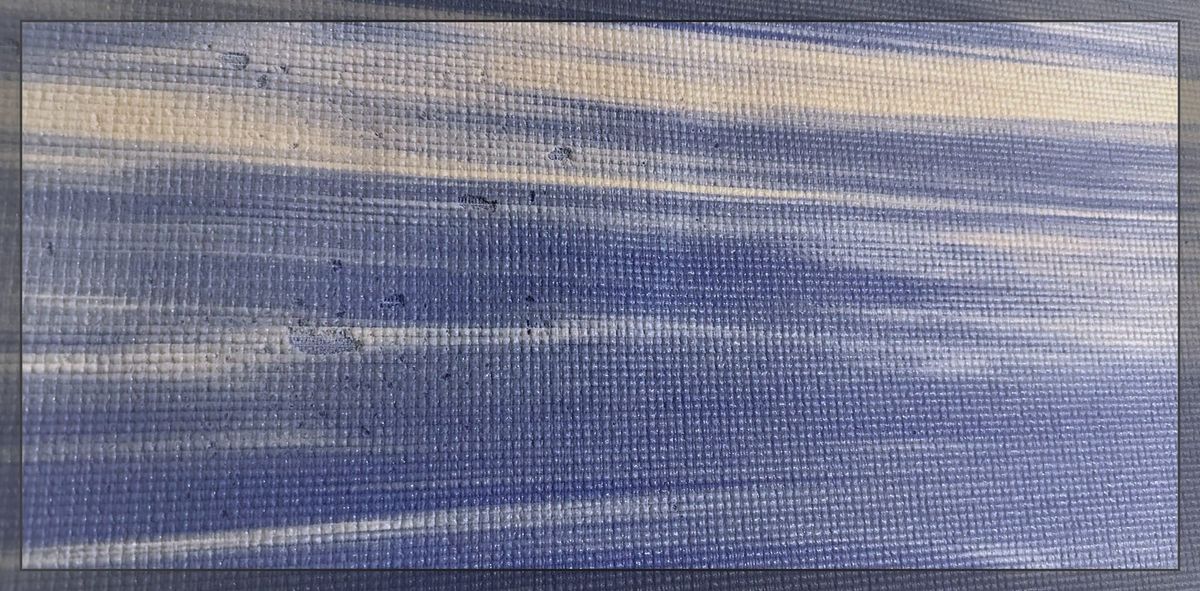
The Science Park, where the sports hall was located, was a long and difficult distance from my dorm. Let’s face it: no one wants to cycle through cold streams of air and across a steep bridge after a relaxing savasana, so I decided to purchase a yoga mat for home practice. Looking online, I discovered Tara Stiles’ yoga classes on YouTube. I followed them at every opportunity in my small dorm room next to my cute little bed. I was there, on my blue mat with white stripes, struggling, sweating, relaxing, releasing, and being present. I hold those memories with a lot of tenderness. I feel so much love and respect for the girl who pushed through hard moments, reaching out to every available tool she had without giving up.
I remember a phrase I have heard often since my early yoga years: "Yoga is life on the mat." These 1.2 square metres are a mirror to life, where one can project what is going on internally. I used to struggle SO much with that—it triggered my anger. "F@k you, woo-woo hippies," was what I used to say. What is that even supposed to mean? How can I bring the complexity of my life—the fears, the past, the dreams, the burdens—onto a yoga mat where all I do is stretch and challenge myself with "cool" poses? It seemed oversimplified; I figured whoever said that must have had everything settled.
It took me many years to understand this: the impatience I showed on my yoga mat—the rushing through poses and the "monkey mind"—was indeed the same speed at which I was living my life. That pace, as it turns out, caused many of the complicated issues I was facing. I was running as fast as I could from my own thoughts and emotions, the same way I was trying to move quickly from the initial sun salutations to the more advanced poses. There is a reason yoga begins with sun salutations (Surya Namaskar), and it is not only the necessity of warming up the body. That part of the practice is where you check in with yourself. You enter this space—these 1.2 square meters—where you are allowed to be yourself, express your emotions, face what is happening, and observe your life as an external observer. No judgment, no expectation. You can meet your physical sensations and, most importantly, your breath. You explore the speed and the quality, and start syncing them with your movement. Alignment begins by approaching the self first.
Actually, I want to correct that: You are not just “allowed to be you”; you are confronted with yourself—a slap in the face, a jolt to the body. This sounds harsh, but I am trying to convey my own experience of that "naked" meeting with the self. Countless times I have started my practice with anger and discomfort arising from expectations of how I shouldn't be or feel. I am tired, I am stiff, I have thick ankles, I have cellulite on my thighs, the person next to me does it better, I am not concentrated enough, I won’t be able to do that pose.
And yet—that’s where the practice actually begins. Not in the perfect pose or the calm breath, but in the moment you stop running from what is already there. Your mind finds the space to explode with what you have been keeping numb all day under your perfectly organized schedule, your workload, and your various obligations. When I picture it, I see the crown of my head open, releasing a time-lapse of flowers, words, trees, bubbles, charred scraps of paper, and shifting shapes in every hue. It’s a release of whatever needs to break the surface in that moment. Like a bouquet of mental creations emerging from the crown of the head and spreading around, eventually landing on the floor and dissolving in space. A fountain of colors leaping into the air and falling down, evaporating into the void. I think I have painted the picture enough! Lol! (Yes I am a millennial, I still say LOL)
That being said, this fountain and bouquet can be full of scary creatures and dark, melancholic colors that you have to face while on the mat. There is nowhere to go and no easy fix—well, at least metaphorically, since you can always hop off the mat and go for a drink. If you decide to stay, there is hard work to be done, which is so incredibly rewarding if you manage to endure it.
That’s the thing about the mat. It doesn't "fix" you. It doesn't heal you in the way Instagram wants you to believe—with perfectly timed transitions, impressive inversions, and cinematic backgrounds. What it does is show you, with loving honesty, exactly where you are. Not where you wish you were, not where you think you should be, but where you actually are. And something shifts when you stop arguing with that. Not overnight. Not dramatically. But slowly, like learning to breathe in a rhythm you didn’t know your body was already familiar with.
So here I am, 14 years and two teacher trainings later. I still feel more like a student than a teacher. But I’ve learned enough to know that what happens on that yoga mat isn’t separate from what happens outside of it — it never was. It is a way of looking at how I live: the patterns I repeat, the fears I avoid, and the moments I rush past because slowing down feels unbearable. To be honest this is why I also decided to become a teacher. To guide students through this journey, being the hand that holds them while navigating, forming the bridge to help them cross the other side, silencing the sirens of aesthetic yoga and creating a space to focus and explore.
I don't know if I'll ever fully get there. But somewhere beneath the doubt, there's a steady feeling that tells me I'm heading in the right direction. I've learned to trust that feeling. It's the same one that put me on that blue mat in a tiny dorm room in Amsterdam, and it hasn't steered me wrong yet.